Introduction:
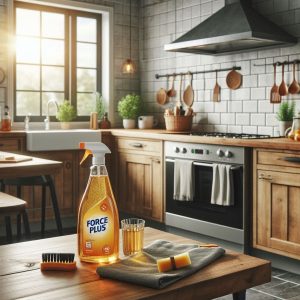
In daily cooking, edible oil and grease in food are directly gasified and oxidized and polymerized under high temperature heating conditions. After condensation, they are attached to the surfaces of range hoods, gas stoves, walls, doors and windows, and then adsorb dust and fibers in the air to form sticky and firm kitchen dirt.
The composition of dirt is very complex, mainly composed of oily polymers, oil fume deposits formed during cooking, food residues, dust and pollutants generated by the utensils themselves. Kitchen dirt not only affects the cleanliness and beauty of the kitchen environment, but also is easy to breed bacteria and produce peculiar smell, which is harmful to human health.
Kitchen oil stain detergent:
The cleaning of kitchen dirt requires the use of kitchen oil stain detergent, which is generally composed of surfactants, solvents, alkaline auxiliaries, chelating agents and other ingredients.
- Surfactants reduce surface tension, wet, emulsify and disperse oil stains and dust.
- Solvents can penetrate, dissolve and disperse oil stains.
- Alkaline auxiliaries can react with fatty acids in oil and fat to generate fatty acid salts, and can also swell the resinous substances formed by unsaturated oil polymers, reducing the bonding force between oil stains and solid surfaces and the compactness of oil stains.
- Chelating agents can chelate various metal ions generated in water and utensils to prevent dirt from depositing.
Low-alkaline oil stain detergent:
Most of the kitchen oil stain detergents on the market are strong alkaline formulas, which can effectively remove heavy kitchen oil stains, but they are also highly corrosive to kitchen utensils.
With the improvement of living standards, consumers have higher requirements for the quality of kitchen oil stain detergents. In addition to having high oil removal ability, the products should also have the characteristics of not hurting utensils and low irritation. Therefore, the development and application of low-alkaline formulas are very necessary.
Research and application of low-alkaline oil stain detergent:
- Test and analyze the composition and insoluble particle microscopic state of several oil stains, and study the effects of different concentrations of weak alkaline auxiliaries triethanolamine (TEA), sodium carbonate (Na2CO3), sodium bicarbonate (NaHCO3), diisopropanolamine (DIPA), chelating agents EDTA-2Na, EDTA-4Na, glutamic acid diacetate tetrasodium (GLDA), and N,N-dicarboxymethylalanine trisodium (MGDA) on different types of oil stains. The detergency and corrosivity were compared with the strong alkaline auxiliary NaOH.
Results:
- The results show that under weak alkaline conditions, organic alkalis have better cleaning effect and low corrosivity, and the four chelating agents have different degrees of detergency enhancement effect.
- The composition of oil stains in different scenarios varies greatly, and the formula should be designed and evaluated for different scenarios.
Conclusion:
The research and application of low-alkaline oil stain detergent is of great significance for improving the cleaning effect of kitchen oil stains, reducing the damage to kitchen utensils, and protecting human health.