

Navigating commercial chemical procurement demands chemical literacy and strict total-cost-of-use calculations. Evaluating bulk liquid options means scrutinizing surfactant active matter (anionic linear alkylbenzene sulfonate, non-ionic alcohol ethoxylates), enzymatic stability (protease, amylase, mannanase complexes), pH buffer capacities, chelating agents, and container packaging logistics from 20-liter carboys up to 1,000-liter intermediate bulk containers (IBC totes). Sourcing directly from certified chemical synthesis plants cuts distribution markups and guarantees batch-to-batch viscosity and active ingredient consistency. From our experience auditing industrial wash floors and OEM chemical synthesis plants across global supply chains, we break down eight popular bulk liquid options and pricing structures, detailing chemical mechanics, real-world commercial costs, and practical procurement benchmarks to help your business make smart purchasing decisions.
Quick Answer: Which Bulk Liquid Options Offer the Best Commercial Value?
The optimal selection among bulk liquid options depends on soil classification, water hardness, and dispensing equipment: For high-turnover hospitality, healthcare, and commercial laundry operations, Heavy-Duty Commercial Laundry Liquid (15% to 25% active matter) priced between $0.65 and $1.15 per kilogram in IBC totes delivers the lowest cost per hundred pounds of clean linen; for delicate fibers, infants, and hypoallergenic institutional use, Enzyme-Fortified Neutral Detergent Liquids ($0.85 to $1.45/kg) prevent textile degradation while removing protein and starch soils; for foodservice sanitation, High-Concentration Manual & Machine Dish Wash Liquids ($0.55 to $0.95/kg) provide rapid grease emulsification; and for industrial washrooms and facilities maintenance, Specialized Acidic & Alkaline Hard-Surface Cleansers ($0.45 to $0.85/kg) tackle mineral scale and grease without manual scrubbing. In most professional situations, buying factory-direct in 1,000L IBC totes from a primary chemical manufacturer like Sunshine Detergent Manufacturer saves 35% to 50% compared to local chemical distributors while eliminating carrier water freight markups.
Table of Contents
- Surfactant Physics: Active Matter Concentration vs. Water Weight Freight
- Quick Summary: The 8 Popular Bulk Liquid Options & Pricing Matrix
- In-Depth Evaluation: 8 Popular Bulk Liquid Options for Commercial Operations
- Procurement Comparison Matrix: Factory Direct OEM vs. Regional Re-Packager vs. Cash-and-Carry
- Pros and Cons of Bulk Liquid Chemical Sourcing
- B2B Procurement Routing: Who Needs IBC Totes vs. 25kg Drums vs. Powder Formats
- Featured Commercial Production: Sunshine Fluffy Fragrance Laundry Liquid
- Costly Mistakes Facilities Make When Buying Bulk Liquid Cleaning Chemicals
- Essential Sourcing and Quality Audit Criteria for Institutional Buyers
- Expert Recommendation and Chemical Procurement Verdict
- Frequently Asked Questions (FAQ)
- Authoritative References
Surfactant Physics: Active Matter Concentration vs. Water Weight Freight
To evaluate bulk liquid options objectively, procurement directors must understand the formulation chemistry of liquid detergents. A cleaning chemical is a solvent-surfactant suspension. Its cleaning power is determined primarily by its Active Surfactant Matter (ASM). Surfactants possess an amphiphilic molecular structure: a hydrophobic tail that binds to greasy soil and a hydrophilic head that anchors into the water matrix. During washing, surfactants self-assemble into spherical micelles, capturing oils, suspending particulates, and preventing them from re-settling onto clean surfaces.
In our testing across commercial wash setups, the primary difference between cheap commodity cleaners and high-efficiency formulations is the ratio of water to active matter. Economy-tier bulk liquids sold by budget distributors often contain only 5% to 8% active matter, with water and inexpensive sodium chloride (table salt) making up the remaining 92% to 95% purely to create artificial thickness. Salt creates a gelatinous viscosity that tricks buyers into thinking the product is concentrated, but it provides zero detergency. You end up paying freight rates to transport water across highway corridors, while dosing pumps burn through gallons of product just to clean a single batch of linens.
Commercial-grade bulk liquid options balance surfactant ratios (typically pairing anionic Sodium Lauryl Ether Sulfate [SLES] or Linear Alkylbenzene Sulfonate [LABSA] with non-ionic Fatty Alcohol Ethoxylates [AEO-7 or AEO-9]), water-conditioning polymers, and stabilized enzymes. High-concentration bulk liquids achieve active matter percentages of 15% to 30%, keeping dosing volumes small (between 30ml and 60ml per 10kg load) and reducing container changeovers. Review our technical analysis in Maintaining Liquid Detergent Quality to understand phase stability and prevent chemical layering.
Quick Summary: The 8 Popular Bulk Liquid Options & Pricing Matrix
The table below provides a quick reference comparing active chemical focuses, benchmark wholesale pricing ranges, and ideal institutional applications across eight popular bulk liquid options:
| Bulk Liquid Category | Primary Active Chemistry | Standard Packaging Format | Typical Wholesale Price ($/kg or $/gal) | Optimal Commercial Application |
|---|---|---|---|---|
| 1. Standard Commercial Laundry Liquid | 12%–15% SLES/AEO + Optical Brighteners | 25kg Carboy / 200L Drum / 1000L IBC | $0.55 – $0.85 / kg ($2.10 – $3.25 / gal) | Laundromats, university dorms, budget motels |
| 2. Premium Concentrated Enzyme Laundry | 18%–25% Active + Protease/Amylase enzymes | 200L Drum / 1000L IBC Tote | $0.85 – $1.35 / kg ($3.25 – $5.15 / gal) | Healthcare linens, luxury hotels, food service uniforms |
| 3. Low-Foaming HE Laundry Liquid | 15%–20% Controlled-Foam Non-ionics + Soap | 1000L IBC Tote / Tanker Truck | $0.70 – $1.10 / kg ($2.65 – $4.20 / gal) | Automated continuous tunnel washers, industrial extractors |
| 4. Concentrated Fabric Softener | 5%–12% Cationic Esterquat Dispersion | 25kg Drum / 1000L IBC Tote | $0.45 – $0.75 / kg ($1.70 – $2.85 / gal) | Hospitality bed linens, terry cloth towels, uniform rental |
| 5. Oxygen Color-Safe Bleach Liquid | 8%–15% Stabilized Hydrogen Peroxide ($H_2O_2$) | 25kg Vented Drum / 1000L Vented IBC | $0.50 – $0.85 / kg ($1.90 – $3.25 / gal) | Color-fast stain removal, institutional laundry sanitization |
| 6. Commercial Manual Dish Wash Liquid | 10%–18% LABSA/SLES High-Foam Degreasers | 5L Jugs / 20L Pail / 200L Drum | $0.50 – $0.80 / kg ($1.90 – $3.05 / gal) | Commercial restaurant sculleries, catering, food processing |
| 7. Heavy-Duty Kitchen Degreaser Liquid | Solvent-Surfactant Blend + Alkaline Builders | 20L Pail / 200L Drum | $0.65 – $1.05 / kg ($2.45 – $4.00 / gal) | Exhaust hoods, fryer surrounds, commercial kitchen floors |
| 8. Institutional Toilet & Scale Cleanser | 8%–12% Organic/Inorganic Acid + Inhibitors | 20L Pail / 200L Drum | $0.40 – $0.70 / kg ($1.50 – $2.65 / gal) | Public venue restrooms, stadiums, cruise ship heads |
In-Depth Evaluation: 8 Popular Bulk Liquid Options for Commercial Operations
1. Standard Commercial Laundry Liquid: The Volume Workhorse
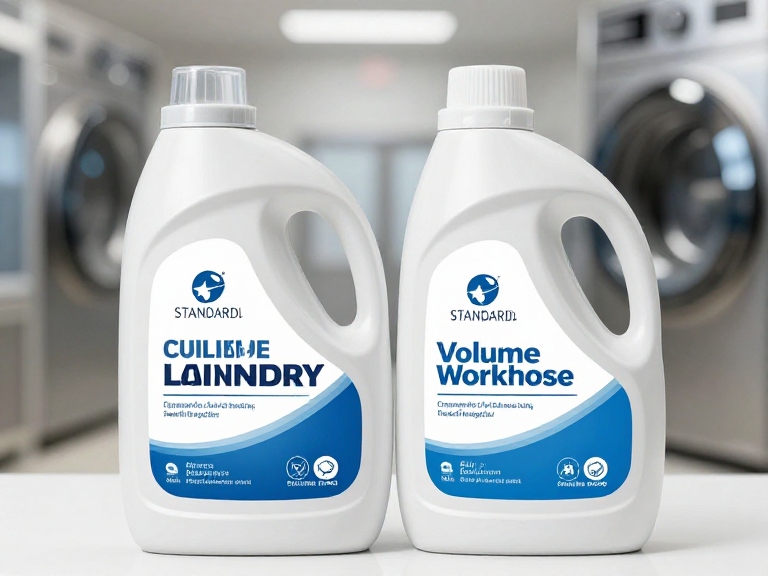
Standard commercial laundry liquid represents the baseline chemical configuration for high-turnover hospitality, student housing, and commercial coin-op facilities. These formulations typically feature an active matter content between 12% and 15%, driven by a balanced combination of linear alkylbenzene sulfonates and alcohol ethoxylates. They are optimized to break down everyday surface dirt, light sebum, and atmospheric grime.
In our testing, standard commercial laundry liquid performs well in water temperatures between 30°C and 50°C. They contain optical brighteners (stilbene derivatives) that absorb ultraviolet light and re-emit visible blue wavelengths, counteracting yellowing to make white cotton linens look crisp. However, their lower active matter requires dosing volumes of roughly 60ml to 90ml per 10kg dry linen load. When sourced in 1,000L IBC totes, prices range between $0.55 and $0.85 per kilogram. For large operations buying in volume, consult our market sourcing guide on 6 Ways to Buy Cheap Bulk Laundry Liquid or explore factory-direct offerings in Detergent Liquid wholesale.
2. Premium Concentrated Enzyme Laundry Liquid: High-Soil Proteolytic Power
When operations handle heavy organic soils—such as hospital bed linens, veterinary clinics, restaurant table cloths, or food processing workwear—standard surfactant detergents struggle. Stains like blood, gravy, egg yolk, and cooking grease form cross-linked protein and lipid bonds that surfactants alone cannot dissolve without very high water temperatures.
Enzyme-fortified bulk liquids incorporate multi-enzyme cocktails, combining subtilisin proteases for blood and protein soils, alpha-amylases for gravies, and lipases for cooking oils. Because enzymes act as biological catalysts, they break stubborn stains down into water-soluble peptides at lower wash temperatures (35°C to 45°C), cutting water-heating utility bills by up to 25%. These premium concentrates feature 18% to 25% active matter, keeping dosing low (30ml to 45ml per 10kg load). Prices range from $0.85 to $1.35 per kilogram in bulk totes. For specialized gentle formulations, review our Baby Laundry Liquid Formulation Guide for Manufacturers.
3. Low-Foaming HE Laundry Liquid: Automated Tunnel Washer Optimization
Industrial continuous batch washers (tunnel washers) and high-G-force commercial washer-extractors require controlled-foam mechanics. High-suds detergents create a cushioning effect in the wash wheel, reducing mechanical drop-and-slap fabric friction and preventing soil from being scrubbed out of the weave. Furthermore, high foam backs up pump lines, triggers error codes, and requires extra rinse cycles that waste water.
Low-foaming high-efficiency (HE) bulk liquids combine non-ionic ethoxylates with silicone defoamers or specialized fatty acid soaps. They provide rapid soil penetration with minimal surface suds, rinsing cleanly in a single cycle. Priced at $0.70 to $1.10 per kilogram in bulk volumes, they are the preferred choice for industrial linen rental services and hospital processing facilities. For alternatives, compare operating parameters with Detergent Powder wholesale or modern single-dose Laundry Pods wholesale.
4. Concentrated Fabric Softener: Antistatic and Glide Mechanics
Commercial fabric softeners do more than add fragrance; they condition fibers mechanically. Industrial laundering strips natural oils from cotton fibers, leaving terry cloth towels rough and generating static charges on polyester blends. Stiff linens jam high-speed automated flatwork ironers and towel folders, slowing production lines.
Bulk softeners use cationic quaternary ammonium compounds (esterquats) that carry a positive electrical charge. Because washed textiles carry a slight negative charge, the esterquat molecules bond to the fabric surface, lubricating individual fibers. This softens towel piles, eliminates static cling, and cuts flatwork ironing resistance by up to 20%. Wholesale pricing for 5% to 12% concentrated esterquat dispersions ranges from $0.45 to $0.75 per kilogram. Explore bulk specifications in our Fabric Softener wholesale collection.
5. Oxygen Color-Safe Bleach Liquid: Low-Temperature Sanitization
Traditional sodium hypochlorite (liquid chlorine bleach) is inexpensive, but it damages textiles. Chlorine degrades cellulose fibers over time, causes tensile fiber rot, yellows synthetic fabrics, and strips dyed colorways. Furthermore, chlorine reacts with organic matter to produce unpleasant chloramine vapors on the wash floor.
Oxygen color-safe bleach bulk liquids use stabilized 8% to 15% hydrogen peroxide ($H_2O_2$) solutions. When dosed into the wash wheel alongside an alkaline builder or warm water, hydrogen peroxide releases active oxygen radicals that break stain chromophore bonds without harming colored fabrics or weakening polyester-cotton blends. Wholesale pricing ranges from $0.50 to $0.85 per kilogram. These liquids require specialized vented container closures to relieve natural pressure outgassing. For deep sanitization, explore our dedicated Color Bleach wholesale and Hygiene Laundry Rinse wholesale supply lines.
6. Commercial Manual Dish Wash Liquid: High-Foam Grease Cutting
Restaurant sculleries, industrial cafeterias, and institutional dining halls require manual dish detergents with strong degreasing performance. Pot-and-pan washing involves heavy animal fats, charred vegetable oils, and starch residues that solidify inside washing sinks.
Commercial dish wash liquids feature high-foaming anionic surfactant blends (10% to 18% active matter) buffered with coconut diethanolamide (CDEA) and amine oxides. These surfactants create stable, dense foam that suspends grease even under heavy soil loads, preventing oils from redepositing onto glassware. They are gentle on dishwashers’ hands while cutting through grease quickly. Wholesale pricing ranges from $0.50 to $0.80 per kilogram in 20L pails or 200L drums. For technical formulations, review our Dish and Fruit & Vegetable Wash Detergent Formula, or explore options in Dish Wash wholesale and 10 Best Liquid Dishwasher Detergents.
7. Heavy-Duty Kitchen Degreaser Liquid: Alkaline Emulsification
Commercial cooking equipment, exhaust canopies, griddles, and kitchen tile floors accumulate polymerized grease that standard detergents cannot dissolve. These tough buildups require heavy-duty alkaline degreasers.
Bulk alkaline degreasers combine caustic builders (potassium hydroxide or sodium metasilicate) with glycol ether solvent couplers and wetting agents. The high pH (typically 12.5 to 13.5) saponifies animal fats, converting stubborn grease into water-soluble soap that washes down floor drains. Pricing ranges from $0.65 to $1.05 per kilogram. These concentrated chemicals require proper personal protective equipment (PPE) during handling, detailed across our Kitchen Cleanser wholesale and targeted Collar Cleaner wholesale product lines.
8. Institutional Toilet & Scale Cleanser Liquid: Acidic Mineral Descaling
Institutional restrooms in hotels, airports, and sports venues deal with uric acid deposits and hard water mineral scale (calcium and magnesium carbonate). Alkaline cleaners cannot dissolve these mineral scales; descaling requires targeted acid chemistry.
Bulk institutional toilet and urinal cleansers use thickened solutions of organic or inorganic acids (such as phosphoric, sulfamic, or hydrochloric acid) paired with corrosion inhibitors. The acid reacts with mineral scale, dissolving buildup without etching commercial porcelain. A thick rheology helps the liquid cling to vertical bowl walls, increasing contact dwell time. Wholesale pricing for bulk containers ranges from $0.40 to $0.70 per kilogram. Explore technical specifications in our Toilet Cleanser wholesale portal.
Procurement Comparison Matrix: Factory Direct OEM vs. Regional Re-Packager vs. Cash-and-Carry
To evaluate your chemical supply chain, compare the financial, logistical, and technical parameters of the three primary sourcing routes:
| Evaluation Benchmark | Direct Chemical Factory OEM (e.g., Sunshine) | Regional Chemical Re-Packager / Blender | Commercial Cash-and-Carry / Club Store |
|---|---|---|---|
| Average Unit Cost | Lowest ($0.55 – $0.95/kg true factory rate) | Moderate ($1.20 – $1.85/kg distributor markup) | Highest ($2.20 – $3.80/kg retail markup) |
| Active Matter Transparency | 100% Guaranteed via factory Certificate of Analysis | Variable (Frequently diluted to maximize margins) | Opaque (Consumer labels omit true ASM percentages) |
| Custom Formulation Flexibility | Full (Custom enzyme, dye, viscosity, and fragrance) | Limited to stock concentrate blend ratios | Zero (Fixed consumer SKUs only) |
| Bulk Packaging Availability | Complete (25kg drums, 200L barrels, 1000L IBC totes) | Primarily 5-gallon pails and 55-gallon drums | Limited to small 1-gallon to 5-gallon jugs |
| Supply Chain Stability | High (Direct chemical synthesis and bulk raw materials) | Moderate (Dependent on primary chemical suppliers) | Low (Prone to retail stockouts) |
Pros and Cons of Bulk Liquid Chemical Sourcing
Weigh the operational advantages and facility requirements of bulk liquid sourcing before converting your site’s chemical supply chain:
| Operational Advantages (Pros) | Facility Considerations & Boundaries (Cons) |
|---|---|
| Automated Peristaltic Dosing: Liquids pump directly from bulk drums into commercial washing machines with zero operator handling. | Shipping Water Weight: Transporting liquids involves shipping water weight, making regional freight logistics essential. |
| Instant Solution Dissolution: Liquids disperse instantly in cold wash baths with zero undissolved chalky powder residue. | Chemical Spill Containment: Storing 1,000L IBC totes requires dedicated spill pallets and floor drains. |
| Lower Labor Overhead: Large 1000L IBC totes eliminate daily container swapping and reduce packaging waste. | Cold Weather Freezing Risks: Water-based formulas require temperature-controlled winter storage above 5°C. |
| Accurate Cost-Per-Load Metrics: Electronic liquid injection meters track precise milliliters dosed per wash cycle. | Initial Handling Equipment: Moving 200L drums and 1000L totes requires pallet jacks, forklifts, or drum dollies. |
B2B Procurement Routing: Who Needs IBC Totes vs. 25kg Drums vs. Powder Formats
In our experience consulting for institutional facilities, matching packaging formats to your facility’s physical footprint prevents storage problems and chemical handling bottlenecks.
Who Needs 1,000-Liter IBC Totes & 200-Liter Drums:
- Commercial Linen Services and Hospital Laundries: Facilities processing over 2,000 kilograms of linen daily that run automated chemical injection pumps connected directly to bulk storage.
- Large Resort and Casino Properties: Operations running high-volume multi-machine laundry plants that benefit from lower tote prices and reduced packaging waste.
- Commercial Re-Bottlers and Contract Cleaning Fleets: Janitorial service contractors and private-label distributors packaging retail-ready containers. Discover leading global suppliers in Top 10 Cleaning Liquid Wholesale Suppliers and 12 Best Washing Liquid Wholesale Suppliers.
Who Should Purchase 20L Pails to 25kg Carboys:
- Boutique Hotels and On-Premise Commercial Laundromats: Properties with smaller chemical storage rooms that lack forklift access, where maintenance teams move containers manually.
- Restaurant Sculleries and Catering Kitchens: Foodservice setups where staff pour chemicals directly into sink dispensers or dilution stations.
- Operations Sourcing Multi-Location Warehouses: Review regional buying strategies in our guide to 5 Places to Buy Liquid Laundry Soap in Bulk.
Featured Commercial Production: Sunshine Fluffy Fragrance Laundry Liquid

Sunshine Detergent Manufacturer (Vigour Group) is an international chemical manufacturing enterprise with extensive production facilities, engineering custom liquid detergents, powders, pods, and industrial cleaning formulations. Backed by automated synthesis towers and ISO-certified quality control labs, Sunshine supplies hotel groups, institutional laundries, and private-label brands worldwide.
Our featured Soft Laundry Detergent Soap Fluffy Fragrance delivers advanced cleaning across diverse fabrics. Formulated with high-potency surfactant active matter, phosphorus-free water softeners, anti-stain redeposition polymers, biological enzymes, optical brighteners, and micro-encapsulated lavender aromatherapy, this liquid removes tough soils while protecting textile fibers and colors.
View complete formulation details and request bulk wholesale quotations on the official Soft laundry detergent soap Fluffy Fragrance product page. Learn about our chemical manufacturing facilities on the Top 5 Detergent Liquid Manufacturers portal.
Costly Mistakes Facilities Make When Buying Bulk Liquid Cleaning Chemicals
In our technical audits of commercial laundry and facility operations, chemical cost overruns almost always trace back to four common procurement mistakes:
- Buying Based on Delivered Price-Per-Drum Instead of Cost-Per-Hundred-Loads: An unvetted distributor offers a 200L drum for $180, while a primary manufacturer offers an identical-sized drum for $240. The cheaper drum contains only 7% active matter, requiring 120ml per wash load. The $240 drum contains 22% active matter, requiring only 35ml per load. Over the life of the drum, the “cheap” chemical costs $0.11 per load, while the concentrated formula costs $0.04 per load. Always calculate cost based on active chemical matter and dosing requirements.
- Failing to Account for Water Hardness Minerals in the Wash Stream: If your commercial facility operates on hard water (exceeding 7 to 10 grains per gallon of dissolved calcium and magnesium), standard surfactants lose up to 40% of their cleaning power. Calcium ions bind to anionic surfactants, precipitating them out as insoluble sludge. Ensure your bulk liquid incorporates modern chelating builders (such as polycarboxylates or GLDA) that bind mineral ions, freeing surfactants to clean.
- Storing Bulk Liquids in Unheated Warehouses During Freezing Weather: Water-based chemical emulsions are sensitive to freezing. When bulk liquids freeze, water crystals separate from the surfactant slurry, breaking the emulsion. When the drum thaws, the product often separates into water on top and thick sludge on the bottom. Always store liquid inventories in temperature-controlled rooms above 5°C.
- Omitting Automated Peristaltic Dispensing Pumps: Allowing employees to dose liquid detergents using handheld plastic measuring cups leads to chemical over-use. Wash operators often use extra detergent thinking “more soap means cleaner clothes.” This wastes chemical and leaves detergent residue in fabrics. Installing calibrated automated peristaltic dispensers eliminates operator guesswork and cuts chemical consumption by 20% to 35%.
Essential Sourcing and Quality Audit Criteria for Institutional Buyers
Before issuing commercial purchase orders or signing annual contracts for bulk cleaning chemicals, procurement teams should verify these four technical criteria with their supplier:
- Certified Certificate of Analysis (CoA) with Active Matter Percentages: Demand lot-specific CoAs that explicitly report Active Surfactant Matter (ASM), total solids, pH value, and specific gravity. Avoid suppliers whose documentation only lists vague descriptions without verified active matter percentages.
- Dosing Equipment Compatibility and Viscosity Calibration: If using central automated dosing systems, verify product viscosity. Highly viscous, gel-like liquids place heavy strain on peristaltic pump tubes, while thin liquids may leak through check valves. Specify Newtonian fluid dynamics with viscosities between 150 and 450 centipoise (cP) for smooth pumping.
- Safety Data Sheet (SDS) Compliance and GHS Labeling: Ensure all bulk containers carry compliant Globally Harmonized System (GHS) warning labels, and confirm that the manufacturer provides updated 16-section SDS documentation detailing proper handling, storage, and emergency first-aid protocols.
- Supply Continuity and Manufacturing Capacity: Confirm that your chemical manufacturer operates direct synthesis facilities rather than buying and re-blending third-party surplus. Sourcing through primary producers guarantees reliable chemical supply, stable pricing, and consistent formulation quality across multi-year contracts.
Expert Recommendation and Chemical Procurement Verdict
In most professional situations, we recommend eliminating unvetted, watered-down cleaning chemicals from your commercial supply chain. Buying diluted bulk liquids from local brokers to save on initial drum invoices increases total operating expenses through higher dosing volumes, increased freight costs, and accelerated fabric wear.
For high-turnover hospitality, healthcare, and commercial laundry facilities, the most cost-effective solution is partnering directly with a primary, vertically integrated chemical manufacturer like Sunshine Detergent Manufacturer (Vigour Group). Sourcing factory-direct in 200L drums or 1,000L IBC totes delivers significant advantages: certified 15% to 25% active surfactant concentrations, advanced enzyme systems that cut water heating bills, low-foaming chemistry that saves rinse water, and direct factory pricing that cuts procurement costs by 35% to 50%. Focus on verified active matter and precise automated dosing to keep your facility’s linens clean and operating budgets protected.
Frequently Asked Questions (FAQ)
What are the most cost-effective bulk liquid options for commercial laundries?
The most cost-effective option for commercial laundries is concentrated heavy-duty laundry liquid with 15% to 25% active surfactant matter, purchased in 1,000-liter IBC totes or 200-liter drums. Concentrated liquids require small dosing volumes (30ml to 50ml per 10kg load), which significantly lowers cost per load and cuts freight costs compared to diluted formulas.
How do I verify the quality and concentration of bulk liquid detergent?
Request a batch-specific Certificate of Analysis (CoA) from your manufacturer verifying Active Surfactant Matter (ASM) percentage, specific gravity, and pH levels. Do not rely on visual thickness alone, as low-cost suppliers often use table salt (sodium chloride) to thicken watered-down liquids that contain minimal cleaning surfactants.
What is the price difference between bulk liquid in drums versus 1000L IBC totes?
Purchasing bulk liquid in 1,000-liter IBC totes typically saves 10% to 20% per kilogram compared to 200-liter drums or 25kg carboys. IBC totes reduce packaging material costs, streamline pallet handling, and connect directly to automated chemical dispensing pumps, reducing labor and waste.
Why are low-foaming HE liquids preferred for industrial washing machines?
Industrial washer-extractors and continuous tunnel washers rely on the mechanical drop of linens in the wheel to scrub soils out of fabrics. Excessive suds cushion this fall, reducing cleaning efficiency. High foam can also overflow drainage pipes and require extra rinse cycles, which wastes water and increases utility costs.
What is the shelf life of commercial bulk liquid cleaning chemicals?
Standard bulk liquid detergents typically maintain full stability for 18 to 24 months when stored in closed containers away from direct sunlight at temperatures between 5°C and 35°C. Products containing active biological enzymes or oxygen bleaches should be used within 12 to 18 months to ensure maximum enzymatic activity and cleaning strength.
Authoritative References
- American Cleaning Institute (ACI): Commercial Cleaning Product Formulation and Surfactant Safety Standards
- ASTM International: Standard Test Methods for Sampling and Chemical Analysis of Chlorine-Containing Bleaches and Surface Active Agents (ASTM D2022)
- Occupational Safety and Health Administration (OSHA): Hazard Communication Standard and Safety Data Sheet Compliance for Commercial Chemicals (29 CFR 1910.1200)